I decided not to write something on the 10th anniversary of the Scottish indyref. Largely because on ‘Scotland’s Day of Destiny’ back in 2014 I was mainly on trains – from London to Edinburgh, musing on how many times I’d done that journey over my lifetime and how it feel to cross an international border as part of it, and from Edinburgh to Glasgow to check in to a hotel over the road from the venue for the Better Together event/party/rally taking place overnight.
The action really began for me at 2am on September 19 when I got up after a few hours sleep and put the TV on as I got dressed just as the Clackmannanshire result dropped. And the independence campaign ended there and then. If Yes could not win the Wee County it would not carry the country.
The Better Together party was in full swing when I arrived. They hadn’t exactly won anything, but they’d prevented something from happening. They were satisfied and relieved rather than jolly. But by all accounts that was some improvement on the atmosphere in Edinburgh where Yes campaigners had convened.
I ended September 19 in Edinburgh. I did the BBC Papers review from the roof of a Grassmarket hotel in the shadow of Edinburgh Castle and joined some BBC folks, including then political editor Nick Robinson, in the bar for a few drinks (they were NOT celebrating the result but were marking the end of a moment in British history).
The anniversary has certainly brought forth some memories and emotions. I sort of feel like I want to talk to those that were there to process it after all this time. But the anniversary has passed with little significant coverage. Which is simultaneously odd and telling.
BBC Scotland screened a documentary on the Salmond/Sturgeon relationship. I watched it mainly to see if I popped up in the background obviously. Obviously I did not.
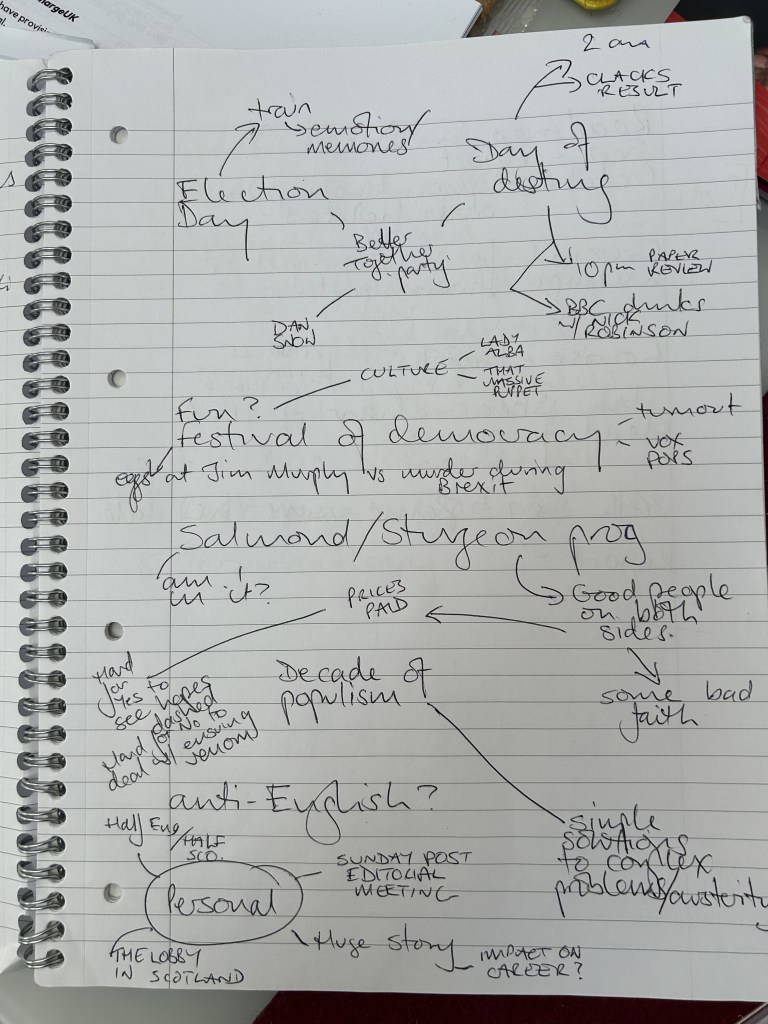
In the end I tried to get my thoughts and memories down on the page. See the accompanying photo. They are not entirely joined up or always comprehensible.
Fundamentally, it was a unique moment combining the personal, the professional and the political.
The personal – I grew up in Scotland, half English and half Scottish (so I like to get drunk and beat myself up, as per the joke a comedian wrote me to tell on stage at Late n Live at the Edinburgh Fringe for a story back in 2001).
I had no vote in the referendum but I had skin in the game and friends on both sides, all of whom paid a price whether that be seeing their hopes dashed or living with personal venom. (There is something satisfying about seeing the likes of Blair McDougall and Martin McCluskey elected MPs just shy of the 10th anniversary, both are good men who had to wait their turn while good folk on the SNP side were elected in shorter order in 2015. Bampots on both sides have been elected since 2014 too.) And in the years since it has been hard to see those that wanted independence have those dreams diminished almost to the point of extinction, particularly in the years when the UK was being run so stupidly and independence looked a better prospect but the bolt had been shot.
The professional – I was working for a Scottish newspaper covering Westminster politics at the time, perfectly placed to report on the biggest story in the UK at the time and one that attracted global attention. For all the serious reporting analysis my greatest hits were definitely the claim that the No side would deploy a ‘dad’s army’ of washed up politicians and the mooted Better Together cup (both seem to have been wiped from the internet).
The Sunday Post was seen as staunchly unionist but only those of us that were in the crucial editorial meeting that decided our line will know the conversations that took place and how close we may have come to backing Yes.
I was invited on panels and TV shows to talk about it. (Though I haven’t checked my diaries from the time I suspect they are largely full of complaints that Scotland’s self style foremost political commentator of the time had more than his fair share of the punditry slots sewn up..) Looking back, it was probably the start of a growth in my confidence and my frustrations that would ultimately see me move on and build a different sort of career within a fairly short space of time. It was a professional trigger point in a good way.
The political – the indyref was the curtain raiser for a series of political upheavals largely characterised by the soap opera style of politics dominated by characters (notable how the BBC Scotland doc focuses on the Salmond/Sturgeon relationship rather than those that had to live in the country they governed while in the process of falling out) and featuring simple solutions to complex problems. You could house it all under the umbrella term ‘populism’ but that would be to succumb to the very problem of simplifying the complicated.
Those of us that reported on the indyref saw so much of it repeated through the Brexit referendum campaign. Claims that exiting the EU was uniquely difficult and that it would’ve been easier to unwind the union between Scotland and England do not ring true.
But it was a particular moment. It was a festival of democracy. Turnout was huge and younger voters were enfranchised and engaged. It was an internet election – what is the Better Together lady that launched a thousand memes doing now? The cultural impact was significant: Lady Alba and that massive puppet that was all over Scotland were fun and quality, but they ultimately had no answer to David Bowie urging Scots to stick in the UK.
Anyway, there’s not really any ‘LinkedIn lesson’ from all this. Something about how there’s good people on both sides of any given argument? How forcing people to make a binary choice has consequences? How we should mark, process and address historical moments no matter how uncomfortable that may be if we’re to learn the lessons from them?
Mainly, just a feeling that the anniversary of a significant moment in my life and in that of the UK shouldn’t pass unmarked. And perhaps this’ll pop up on Google when producers are looking for talking heads for the 20thanniversary of indyref documentary.
 James Millar